Sync Quote Gen · Product Concept & Process Design
Turning complex BOQs into consistent, decision-ready proposals
Part of the Synchronos portfolio
Every Synchronos project begins with a bill of quantities — hundreds of line items across automation, AV, lighting, security and interiors — and ends, commercially, with a proposal a client has to be able to read and decide on. For years the distance between those two documents was hours of manual work per proposal.
Sync Quote Gen closes that distance. It is an internal application that turns a BOQ spreadsheet into a consistent, print-quality proposal — and it was built the way I believe operational software should be: deterministic where money is involved, assisted where words are.
A real operating need
This was not a product looking for a market. The pain was in-house: proposals drifted in format, pricing errors crept in through copy-paste, and each estimator produced a slightly different document. A client comparing two Synchronos proposals should see one company. The application exists to make that the default rather than an act of vigilance.
Where the machine is trusted, and where it is checked
The division of labour is deliberate. Parsing, calculation, totals and layout are deterministic — the same BOQ produces the same figures every time, across several Excel template generations that remain supported. Narrative passages can be drafted with AI assistance, but behind a deterministic fallback, so the application produces a complete proposal even with no AI provider configured — and it runs fully offline in that mode.
Then the output is checked. A financial QA pass verifies that the document’s totals agree with the parsed BOQ; a layout pass paginates the rendered document with a real browser engine so an A4 proposal breaks where it should. Nothing reaches a client on the assumption that generation worked — the application inspects its own output first.
The shape of the workflow
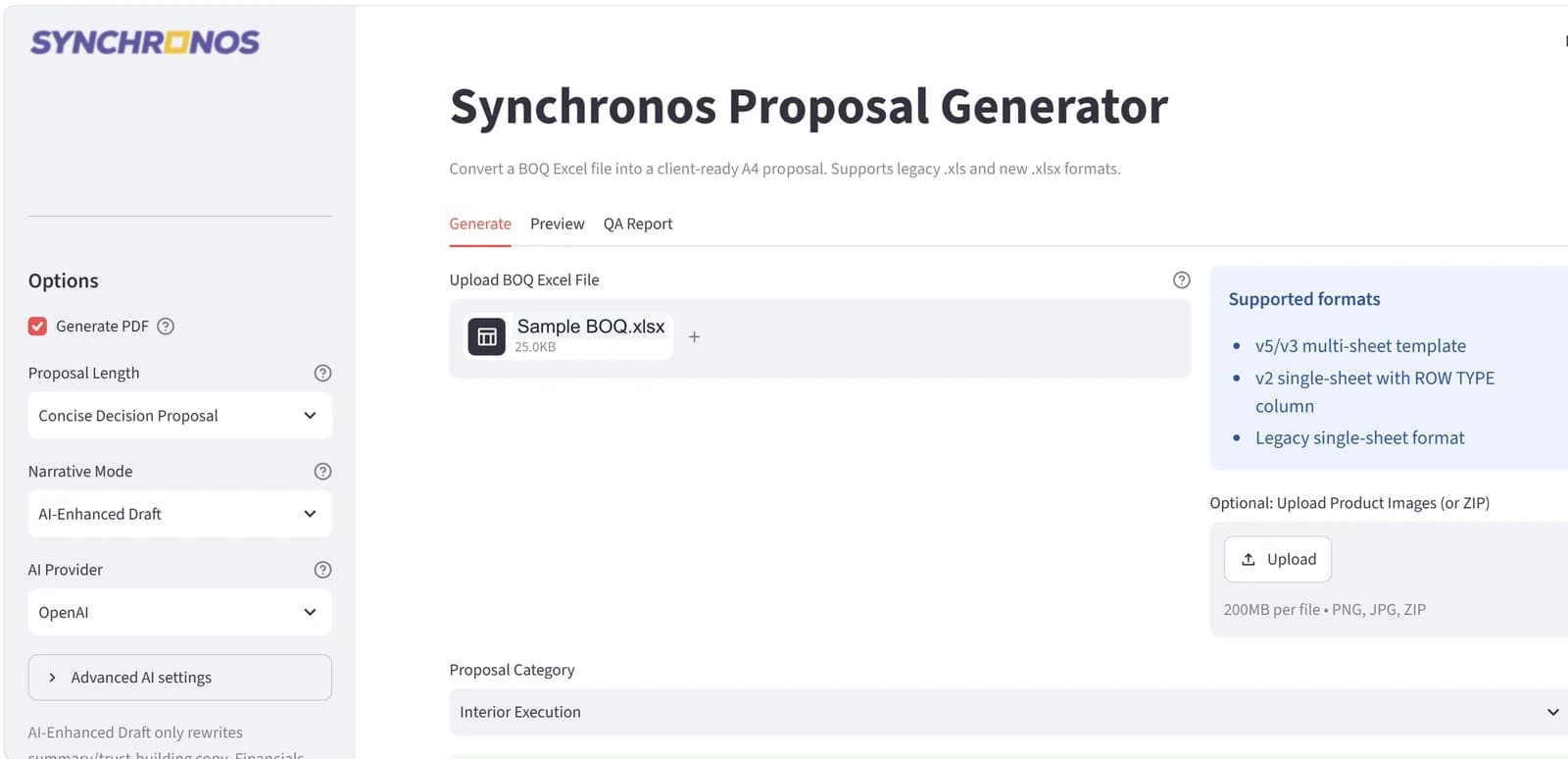
An estimator uploads a BOQ through a simple interface, chooses concise or detailed mode, previews the assembled proposal and exports the finished HTML or A4 PDF. What used to be hours of formatting is now minutes of review — and review, not writing, is where a human adds value.
Current stage
A completed internal application at its first production release, used against real Synchronos proposal workflows. It is an internal tool, not a product offered for sale.
- 01
BOQ
The estimator’s spreadsheet, as it is
- 02
Parse
Multiple template generations supported
- 03
Validate
Figures checked before anything renders
- 04
Structure
Products, categories and narrative assembled
- 05
Render
Print-quality HTML and A4 PDF
- 06
Inspect
Financial and layout QA on the output
- 07
Deliver
A proposal a client can decide on
What the work taught me
The most useful AI systems I have built treat AI as a component, not an author. Giving the assistant a bounded job — drafting prose inside a deterministic document pipeline with its own QA — produced something an operations team can actually trust. Trust in automation is earned at the boundaries, where the system checks itself.
The pattern proven here — controlled AI inside a governed workflow — is the same one QuoteFlow AI applies to the wider sales process.